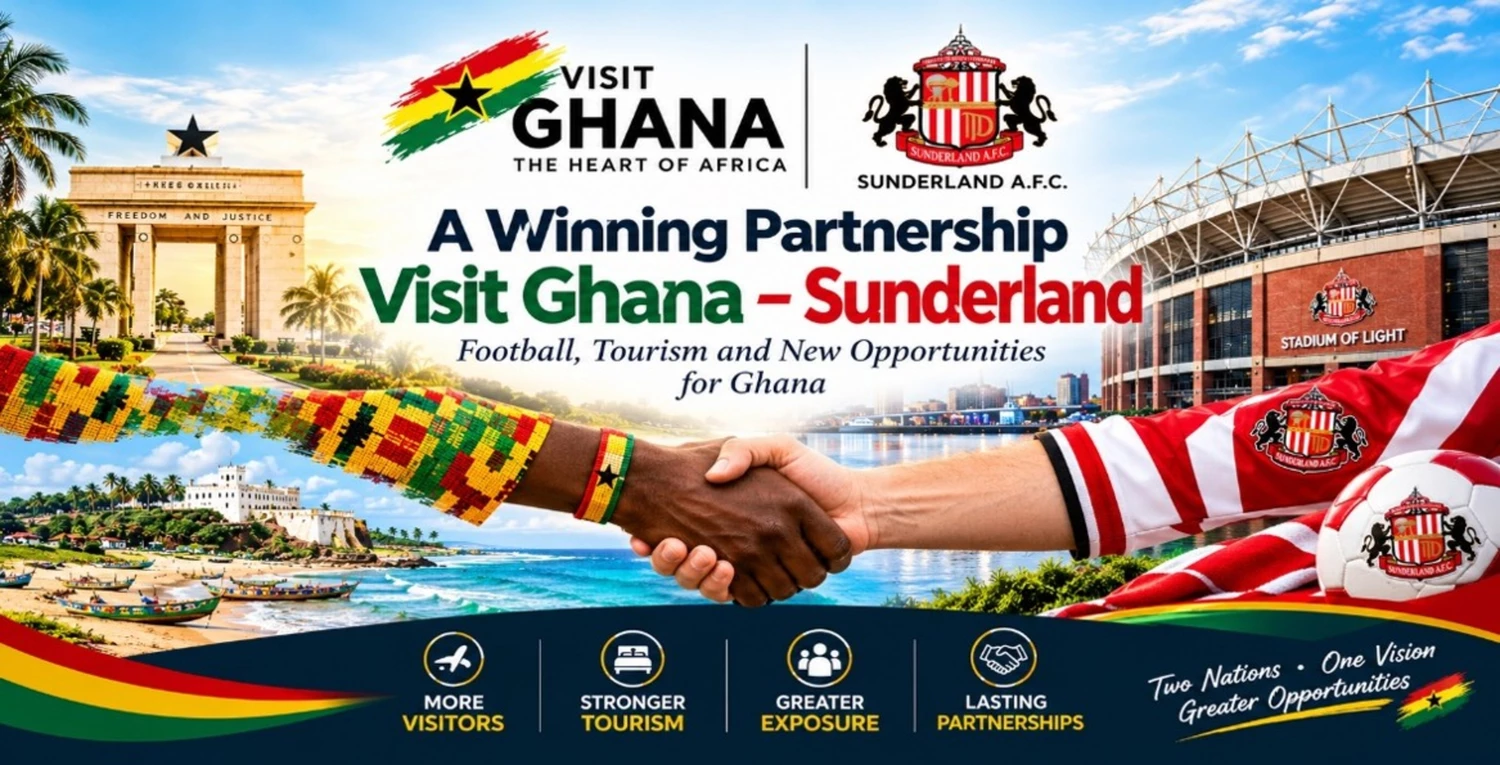
Ghana is reportedly preparing to enter into a major tourism marketing partnership with Sunderland Football Club, potentially placing the Visit Ghana brand prominently on the club's shirt. It is, without doubt, an exciting proposition.
The Premier League is one of the most powerful global platforms for destination visibility. Millions of people across the United Kingdom, Europe, Africa, Asia and other parts of the world follow the competition every week. Associating Ghana's tourism brand with an English Premier League club can create awareness, curiosity and conversations about Ghana in markets that matter. I therefore have no fundamental objection to the idea. In fact, I believe Ghana should be much more aggressive in using sport, entertainment, culture, music and international personalities to promote the destination. But there is a much bigger question that we need to ask: What happens after the visibility?
Because Ghana's tourism problem, in my view, has never been simply a lack of visibility. Our bigger problem is our ability to convert visibility into arrivals, arrivals into experiences, experiences into expenditure, and expenditure into sustainable economic benefits for communities and businesses. And perhaps even more importantly: Are we ready for the numbers we are asking for? Ghana is already visible. Ghana has enjoyed extraordinary international visibility over the past decade. The "Year of Return" placed Ghana at the centre of global conversations about Africa and the African diaspora. "Beyond the Return" extended that conversation.
Our music industry has produced internationally recognised artistes. Our creative sector continues to attract attention. Our footballers play at the highest levels of European football. International celebrities regularly visit Ghana. Our beaches, heritage sites, festivals, cuisine and cultural experiences have attracted considerable international interest. Then there is "December in Ghana", which has become a major cultural tourism phenomenon. Ghana has received endorsements from global celebrities and influential personalities that many destinations would spend millions trying to manufacture. The question, therefore, is not simply: "How do we make the world see Ghana?" The question should be: "How do we make the people who already see Ghana decide to come?" And after they come: "How do we make them stay longer, spend more, return and encourage others to come?" That is a fundamentally different tourism strategy.
The Sunderland opportunity is therefore bigger than the shirt
If properly structured, the Sunderland partnership could be much more than putting "Visit Ghana" on a football jersey. The real opportunity is to create a tourism conversion ecosystem around the partnership. Imagine, for example, if every major Sunderland – Ghana tourism campaign was connected to actual travel products. A fan sees Visit Ghana on the shirt. They scan a QR code. They are taken to an attractive Ghana tourism platform. They see actual holiday packages, flights, hotels, attractions, festivals, football tourism opportunities, heritage experiences, beach holidays, medical and wellness tourism opportunities. They can immediately understand how much it costs to visit Ghana, what they can do when they arrive and how they can book. That is marketing that converts. Otherwise, we risk spending money to make people aware of Ghana without building the mechanism that transforms awareness into economic activity.
The uncomfortable question: can Ghana handle a significant increase in visitors?
This is where the national conversation needs to become more serious. Suppose the Sunderland partnership succeeds beyond expectations. Suppose Ghana suddenly experiences a substantial increase in visitors from the United Kingdom and other European markets. What happens? Where do they stay? How do they move around? How quickly can they move from Accra to Cape Coast, Elmina, Kakum, Kumasi, Mole or other destinations? What is the quality of the roads leading to our major attractions? Are our tourism sites adequately maintained? Do we have enough trained tour guides and quality accommodation at different price points? Can our attractions handle significantly larger visitor numbers without deteriorating? Are our airports and aviation networks sufficiently connected to the destinations we are promoting? Do we have enough domestic flights and efficient intercity transportation? Are tourists able to obtain reliable information before and during their trips? Can they make digital payments easily, access reliable internet connectivity and get assistance when something goes wrong?
And perhaps most importantly: Are we designing the tourism experience around the visitor, or are we expecting the visitor to adapt to us? These are not anti-tourism questions. They are pro-tourism questions. Visibility without infrastructure can become a liability. There is a danger in thinking that tourism is primarily a communications problem. It isn't. Tourism is a complete ecosystem. You can market Ghana to 100 million people, but if the destination experience is poor, the marketing eventually works against you. The first visitor may come because of an advertisement. The second visitor often comes because of the first visitor's recommendation. And today's traveller has the ability to share their experience with the world instantly. A bad airport experience can be posted online. A poor hotel experience can be reviewed publicly. A frustrating transportation experience can become a social media story. An attraction that is poorly maintained can be photographed and circulated globally. The same digital platforms that can promote Ghana can also expose our weaknesses.
Destination reputation is no longer controlled exclusively by the destination marketer.
The tourist has become part of the marketing department. The numbers should make us think differently. According to GTA’s Annual Tourism Report in 2025 Ghana recorded 1,306,962 international tourist arrivals compared with 1,288,804 in 2024, a growth of approximately 1.4%. Those numbers are important. But the more important question is what we are getting from those visitors. Tourism should not be measured only by how many people cross our borders. We need to ask: How much did they spend? How long did they stay? Where did they stay? Which regions did they visit? How much did local businesses earn? How many jobs were created? How much did communities benefit? How many returned? How many recommended Ghana to others? Recent reporting on the 2025 tourism performance is particularly instructive because, despite the increase in international arrivals, tourism receipts reportedly declined. That should force us to reconsider what we mean by tourism success. More tourists do not automatically mean more tourism value. The objective should be higher-value tourism. Ghana should prepare before it promotes. The Sunderland partnership should therefore become a catalyst for something much bigger: a national Destination Readiness Programme.
Before aggressively asking the world to come, Ghana should undertake a serious audit of our capacity.
- Accommodation capacity: We need to know exactly how many quality rooms exist across the country, where they are located, what standards they meet and whether they can accommodate increased demand during peak periods.
- Transport infrastructure: A tourist should not spend six hours travelling a relatively short distance because of poor roads, congestion or inefficient transport systems. Tourism infrastructure is not only about airports. It is about the entire journey.
- Attractions: Our attractions must be properly developed, maintained, interpreted and packaged. A beautiful attraction that is difficult to access, poorly maintained or inadequately interpreted is not yet a competitive tourism product.
- Human capital: If Ghana succeeds in attracting more tourists, we will need more professional tour guides, drivers, hotel employees, restaurant workers, destination managers, and customer-service professionals. Marketing without human-capital development creates an imbalance.
- Digital tourism infrastructure: The visitor journey increasingly begins before the traveller boards an aircraft. Visitors want to search, compare, book, pay, communicate and navigate digitally. Ghana needs a much stronger digital tourism ecosystem connecting inspiration to transaction.
- Aviation connectivity: There is little value in convincing someone to visit Ghana if the cost and difficulty of getting here remains a major barrier. Tourism marketing and aviation policy therefore need to work together.
- Safety, cleanliness and destination management: Tourists don't only buy attractions. They buy confidence. They need to feel safe, clean public spaces, reliable transportation, clear signage, functioning emergency systems, to know that someone will help them when things go wrong. These seemingly ordinary issues determine whether a destination becomes competitive or not.
We should not fear large numbers, but we must prepare for them
There is another important argument here. Some people may interpret concerns about infrastructure as an argument against aggressively promoting Ghana. It is not. Quite the opposite. We should aggressively promote Ghana. But promotion must happen alongside investment. If Sunderland can put Ghana in front of millions of football fans, then government and the private sector must simultaneously be asking: What will happen if one hundred thousand additional people decide to visit Ghana because of this campaign? What happens if Ghana becomes capable of attracting one million international visitors? That is the strategic question. A country should not build tourism policy around the number of tourists it currently receives. It should build infrastructure around the number of tourists it aspires to receive.
From "visit Ghana" to "experience Ghana"
This is perhaps the most important shift Ghana needs to make. We have become very good at telling people to Visit Ghana. We now need to become exceptionally good at helping them experience Ghana. The difference is enormous. "Visit Ghana" is a marketing message. "Experience Ghana" is a product strategy. The first tells people where to go. The second tells them what they can do, how they can do it, how much it costs and why it is worth their time. The Sunderland partnership should therefore be linked to actual experiences. Football fans could be offered heritage packages. Diaspora visitors could be offered ancestry and cultural experiences. Families could be offered beach and leisure packages. Young travellers could be offered adventure and festival experiences. Business travellers could be encouraged to extend their stays for leisure. And visitors should be encouraged to explore beyond Accra. That is how visibility becomes value.
We need to move from campaigns to conversion
Ghana has had many successful tourism campaigns. But the next generation of tourism marketing should be judged differently. Every major campaign should have measurable conversion indicators. How many people saw it? How many searched for Ghana, visited the tourism website, requested information, booked flights and accommodation? How many travelled?. If we cannot answer these questions, we may be measuring publicity rather than tourism performance.
The real opportunity for government
Government should therefore see the Sunderland initiative not simply as a sponsorship or advertising opportunity. It should be treated as a national tourism readiness test. If we are prepared to put Ghana in front of millions of Premier League viewers, then we should be prepared to ensure that every person inspired by that exposure encounters a destination capable of delivering on the promise. This means bringing together: Tourism, Aviation, Transport, Immigration, Local Government, Hospitality, Private Sector, Digital Technology and Security. Tourism cannot be left to the tourism ministry alone. The visitor's experience begins long before they reach a hotel.
The ultimate question
Are we marketing a destination or preparing a destination? Because these are two different things. Ghana does not have a visibility crisis. Ghana has a conversion and destination-readiness challenge. The world has heard about Ghana. The world has seen Ghana. The world has talked about Ghana. The world has celebrated Ghana. The opportunity before us now is to ensure that when people finally decide to come, the Ghana they experience is as compelling as the Ghana we have promised them.
The Sunderland partnership could therefore be an excellent investment, but only if we measure its success not by how prominently "Visit Ghana" appears on a football shirt, but by what happens after somebody sees it. Can Ghana handle the success it is asking the world to give it?
That is the conversation we should be having now. Because the greatest tourism marketing campaign Ghana can ever have is not an advertisement. It is a visitor who comes to Ghana, has an exceptional experience, goes home and tells ten other people: "You need to go to Ghana."


