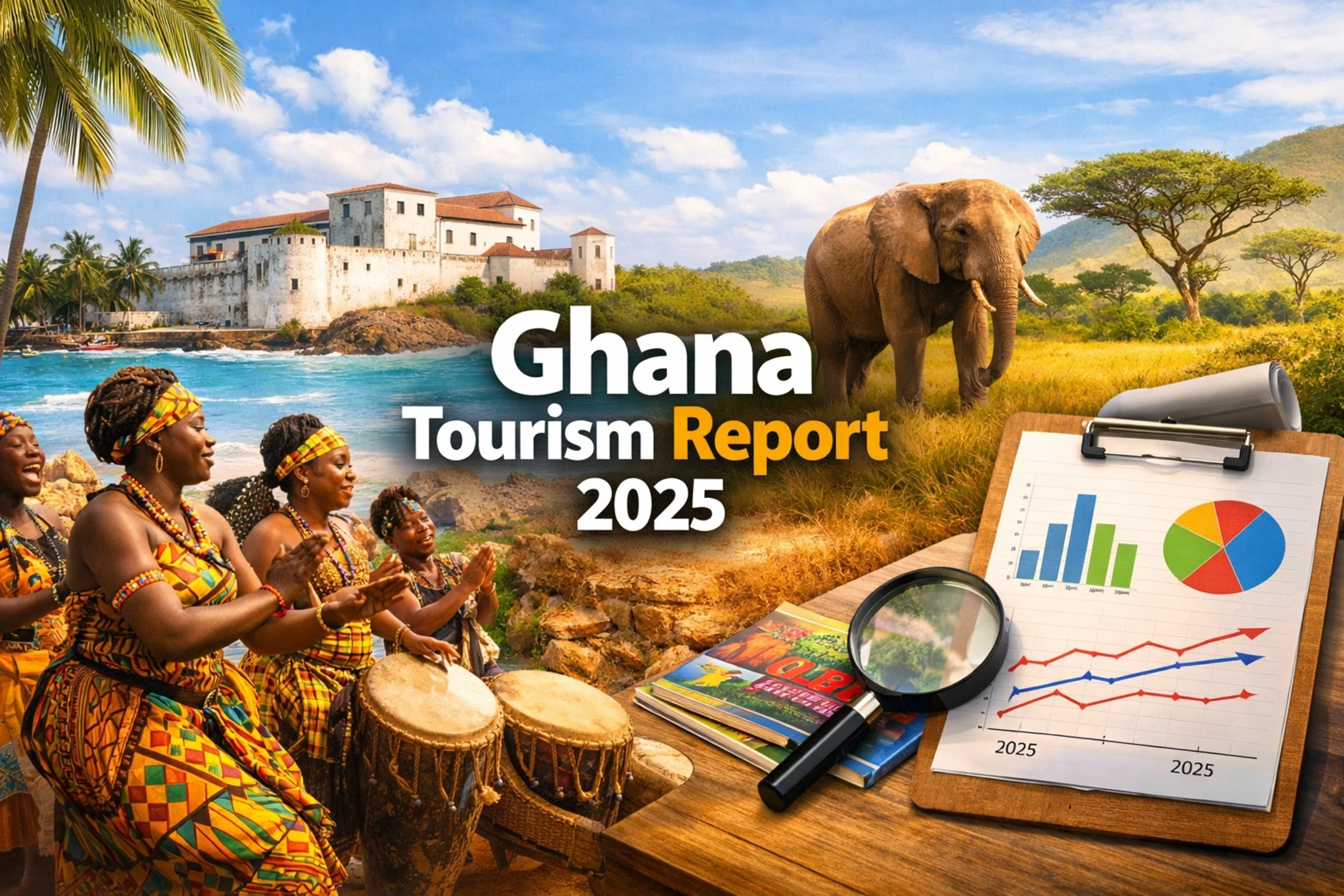
The release of the Ghana Tourism Authority's 2025 Tourism Report under the theme "Resilience and Sustainable Growth" provides an important opportunity for reflection on the state of Ghana's tourism sector. Beyond being a statistical publication, the report serves as a barometer of the industry's performance, competitiveness, and contribution to national development.
As a tourism consultant, analyst, researcher, and President of the Africa Tourism Research Network (ATRN), I commend the Ghana Tourism Authority (GTA) for continuing the important tradition of documenting sector performance and making tourism data available to policymakers, investors, researchers, and industry practitioners. I must say though, the time of publication of 2025 Tourism Report in June 2026 is NOT acceptable.
The 2025 report presents encouraging developments, but it also raises critical questions that require deeper examination if Ghana is to achieve its ambition of becoming Africa's preferred tourism destination.
The Good News: Evidence of Sector Resilience
The strongest message emerging from the report is that Ghana's tourism sector continues to demonstrate resilience despite global economic uncertainties. International tourist arrivals increased from 1,288,804 in 2024 to 1,306,962 in 2025, representing a growth of 1.4 percent. While modest, this growth confirms that Ghana has maintained its position as one of Africa's leading tourism destinations. Domestic tourism also remained strong, with approximately 1.79 million visits recorded across 55 tourist sites nationwide.
What was particularly encouraging is the continued success of the "December in GH" initiative. December 2025 arrivals increased by over 11 percent compared to December 2024, demonstrating the growing attractiveness of Ghana's festive tourism products and the effectiveness of diaspora-focused tourism campaigns.
It was also noted that the growth in licensed tourism enterprises from 6,702 to 7,109 is another positive indicator. This expansion reflects increasing investor confidence and suggests that tourism remains an attractive sector for entrepreneurship and job creation. Similarly, growth in travel trade activities and the meetings, incentives, conferences, and exhibitions (MICE) segment demonstrates the diversification of Ghana's tourism economy.
The report also highlights progress in cruise tourism, with 18 cruise ship calls and more than 5,400 passengers arriving through the ports of Tema and Takoradi. This is significant because cruise tourism remains an underdeveloped but high-potential segment for Ghana and West Africa if harnessed.
The Not-So-Good News: Growth Below Potential
While growth is positive, it is important to place the figures in context. A 1.4 percent increase in international arrivals is significantly below the growth rates recorded by several competing African destinations and below overall African tourism growth trends. Ghana should not only be celebrating growth; it should be asking whether that growth is sufficient given the country's investments in tourism promotion, infrastructure, opportunities available and destination branding.
The reality is that Ghana possesses world-class tourism assets, including heritage sites, cultural festivals, ecotourism attractions, wildlife resources, and a strong diaspora connection. Therefore, modest growth should not be the benchmark for success. The sector appears to have entered a period of stabilisation rather than acceleration. The challenge now is how to move from incremental growth to transformational growth.
The Biggest Concern: Declining Tourism Receipts
Perhaps the most concerning revelation in the report is the decline in international tourism receipts.
According to the report, international tourism receipts fell from approximately US$4.83 billion in 2024 to US$4.34 billion in 2025 despite an increase in arrivals.
This development raises several important questions:
- Are tourists spending less per visit?
- Are visitors staying for shorter periods? This seems to be not reflected in the report.
- Is Ghana attracting lower-spending visitor segments?
- Are there weaknesses in tourism expenditure measurement?
- Is there revenue leakage within the tourism value chain?
For researchers and policymakers, this should become a priority area for investigation. Tourism success cannot be measured solely by arrival numbers. What ultimately matters is visitor spending, economic impact, job creation, and local value retention. A destination that attracts more visitors but earns less revenue may be experiencing structural challenges that require urgent policy attention.
Missing Pieces and Gaps in the Report
While the report provides valuable statistical information, several important dimensions remain underdeveloped.
1. Limited Tourism Satellite Account (TSA) Analysis
The report would have been significantly stronger if it included more detailed Tourism Satellite Account indicators.
Modern tourism reports should not only present arrivals and receipts but also clearly demonstrate:
- Tourism's contribution to GDP
- Tourism employment figures
- Tourism's contribution to foreign exchange earnings
- Regional economic impacts
- Value chain linkages
According to gbcghanaonline.com, Ghana has made progress in developing tourism satellite accounting. Future reports should integrate these findings more comprehensively. GTA should work closely with the Ghana Statistical Service.
2. Inadequate Regional Performance Analysis
The report largely presents national-level statistics. However, tourism development is inherently regional. Stakeholders need to understand:
Which regions are growing fastest| Which attractions are performing best| Regional tourism investment trends| Visitor distribution patterns
Such information would support evidence-based regional tourism planning.
3. Absence of Sustainability Indicators
The report is titled "Resilience and Sustainable Growth," yet sustainability indicators are totally absent in the report.
Future reports should measure: environmental impacts, carbon footprint reduction initiatives, community benefits, conservation outcomes, and sustainable tourism certification uptake if any at all. Sustainability should move from a theme to a measurable performance indicator.
4. Weak Coverage of Digital Tourism Trends
Globally, tourism is increasingly driven by digital technologies, artificial intelligence, smart tourism systems, and online consumer behaviour.
Although Ghana has made strides in tourism digitisation, future reports should track: Online booking trends, digital marketing performance, social media influence, visitor digital experiences and smart destination initiatives. Digital competitiveness is becoming a major determinant of tourism success.
What Must Be Added to the 2026 Tourism Report
To strengthen tourism intelligence and policymaking, I recommend that the 2026 report include the following:
A Tourism Competitiveness Dashboard
Benchmark Ghana against key African competitors such as: Kenya, Rwanda, South Africa and Morocco. Comparative performance analysis will help identify strengths and weaknesses.
Tourism Employment Statistics
The report should provide: Direct employment, indirect employment, youth employment, women employment and regional employment distribution. This will demonstrate tourism's true socio-economic contribution.
Investment Tracking
Include data on: New tourism investments, hotel development pipeline, foreign direct investment, and public tourism infrastructure investments. Investors need visibility into market opportunities.
Domestic Tourism Index
Domestic tourism is increasingly becoming the backbone of resilient tourism economies. A dedicated domestic tourism index should track: Regional travel patterns, school tourism (excursions/educational tours), religious tourism, weekend travel, and business travels.
Visitor Satisfaction Index
Measuring visitor satisfaction is essential. Indicators should include: service quality, transportation experience, attraction quality, and destination recommendation rates. These key indicators were conspicuously missing in the report.
Community Tourism Impact Assessment
Tourism must be measured not only by visitor numbers but also by community benefits. Future reports should assess: Local income generation, community participation, poverty reduction impacts, cultural preservation outcomes.
Looking Ahead
The 2025 Tourism Report demonstrates that Ghana's tourism sector remains resilient and continues to grow despite challenging global conditions. This achievement deserves recognition.
However, the report also reveals that Ghana may be approaching a growth plateau. Modest arrival growth, declining receipts, and gaps in tourism intelligence suggest that the sector must evolve beyond traditional performance measures. Ghana must start looking into diversifying her tourism offering and attracting different source market the Europe (Germany) and Asia (China).
The next phase of tourism development should focus on increasing visitor value rather than simply visitor volume; strengthening domestic tourism; enhancing destination competitiveness; improving data quality; promoting sustainability; and ensuring that tourism benefits local communities.
The future of Ghanaian tourism will not be determined solely by how many visitors arrive, but by how much value tourism creates for businesses, communities, workers, and the national economy.
As Ghana positions itself as the gateway to Africa and the home of the Black Star Experience, the challenge for policymakers and industry leaders is clear: move from resilience to competitiveness, from recovery to transformation, and from growth to inclusive and sustainable prosperity. The 2026 Tourism Report should therefore not only tell us how tourism performed; it should tell us how tourism transformed Ghana.